Friday, 13 April 2012

Frugal Coffee Drinking

An exceptionally frugal colleague of mine asked me this week: is it cheaper to drink coffee made in a plunger, or coffee in those little instant sachets you just add hot water to?

I don’t think he realised what he had unleashed until I provided him with the following breakdown.
 
Our office provides boiling water, milk, sugar, and poor quality instant coffee powder. So theoretically we could drink coffee all day for free - except that the free coffee powder is disgusting. That’s option one: free, disgusting coffee.
 
Another option is to buy a jar of decent quality instant coffee powder and use it instead of the gross stuff. A 200g jar of Nescafe Gold costs $16.69 and contains 117 servings, so that’s 14.26 cents per cup of coffee.


Or you could buy ground coffee and a plunger. A single serve plunger will cost you anywhere from $10 up. Let’s assume you’re reasonably savvy and buy it at that price. A 200g package of ground coffee costs $6.93 and contains approximately 40 servings, so each cup of coffee costs you 17.33 cents plus your capital outlay of $10 for the plunger.


My frugal colleague uses ground coffee in a plunger some of the time, but he also uses instant sachets for cappuccinos on other days. They cost 63 cents each, so I was able to give him the quick answer that the plunger-made coffee was cheaper than the sachets.


There’s a more luxurious option: buy yourself a coffee machine and a thermos, and bring your hot coffee into work. Let’s say you’re lazy like me, so the only way you’re going to use a coffee machine is if it’s easy – this limits your choice to the machines that turn tiny alfoil sachets into coffee. I don’t understand this process, so I assume it’s some kind of magic involving tiny alchemist barista elves. I’ve been looking at buying a Nespresso Pixie as a present for someone, and it seems like the best price is about $300. A good quality thermos costs $20. The Nespresso capsules cost between 68 and 75 cents each. You’ll be using your own milk for this scenario, and 250ml of milk will cost you about 41 cents. So this option requires a capital outlay of $320 plus a cost per cup of at least $1.09. This is relatively expensive in terms of "homemade" coffee, but cheaper than buying a barista-made cup by a wide margin.


Of course you could always do what I did for years, and treat yourself to a café coffee each morning. The café at the foot of my office building provides a discount to local workers, so a regular sized flat white sets you back $3 instead of $4.50 (or more) at other cafes. The staff all learnt my name within a few weeks of the building opening, which I LOVE but I also think is probably a ploy to inspire brand loyalty. It works - if I'm buying a coffee during my work day, there's no way I'm going anywhere other than that Coffee Club outlet. I used to think it was just fine to spend $3 on a cup of coffee every day. Then it occurred to me to start looking at my expenses as annual costs rather than daily, weekly or monthly expenditure. Assuming you get four weeks of annual leave, you work about 240 days a year. That $3 cup of coffee just turned into a $720 annual fee.


Don’t get me wrong – I don’t think it’s always worth spending less money than you could on life’s little luxuries. Some days I really want that flat white, so I buy one, and I don’t feel guilty. But your everyday habits involving small amounts of cash add up in the long term. That’s why it’s a good exercise to look at your budget and expenditure across the year, not just that pay period. You might love coffee enough to spend $720 a year just for that morning cup on work days. I don’t. I love it enough to bring my own jar of instant coffee into work and drink that most days (that’s a $34.22 a year habit) and only buy barista coffees when I really, really want one. Because if that means I spend $500 less a year on coffee, that’s $500 a year I could spend on clothes, books, eating out at fancy restaurants, or paying down the mortgage. Or if you’re digging your way out of poverty, it’s $500 towards your emergency fund or paid off your credit card debt.

I would also think about the other factors here – are you really going to bother making a cup of coffee at home each day and carrying it in to your office in a thermos, or is that too hard for you? I don’t know that I’d bother to do it. Do you feel like the break from staring at the computer screen for fifteen minutes is worth the cost of the coffee you buy on that trip to the café? I know a lot of people cherish that coffee buying break, so it's worth it to them. If every cent you earned was committed to other areas, you’d be willing to drink that gross free coffee to avoid overdrafts on your bank account, but otherwise the point of mindful spending isn’t always to spend as little as possible. It’s that you know how much your coffee costs so you can choose whether or not it’s worth the money to you.

Keep in mind that my costings are based on only one cup a day, and having an office that provides everything you need for your coffee - except that its coffee powder will make your eyes water, and not in a good way.

Luckily my colleague was very patient with me while I gave him a full cost analysis of his coffee options.

Thursday, 12 April 2012

Adventures with the Cookie Press

I finally got my hands on the family recipe for "forcer cookies". They're custard cookies made using a cookie press, also known as a cookie forcer. I just had to take a million photos because they're super cute!


Here you can see my cookie press, which is very modern...


And a 1970s (I think) model which my aunty bought on ebay:


This 1970s model is very similar to the one my aunty uses, which she bought in 1973 for $4.50. My cookie press was a present, but I'm guessing they cost a fair bit more than $4.50 these days.

You can see how the range of aluminium shapes compares with the vintage selection on the left, and the selection for the modern model on the right:


And you can see the shapes I tried out this time...


I can't share my recipe because it's a family secret. But there are lots of great recipes out there for custard cookies. I recommend googling "cookie recipe custard powder" or similar. And custard cookies taste best when made into little sandwiches with vanilla icing as the filling.

Now it must be time for a cup of tea and a custard cookie!

Monday, 9 April 2012

Carrot Cake - No Egg!

These little cakes are moist, flavourful and a real hit.


Ingredients:
1 1/2 cups self raising flour
1 teaspoon cinnamon
1 teaspoon nutmeg
1 teaspoon mixed spice

2/3 cup brown sugar
175ml vegetable oil
200ml plain yoghurt
1 tablespoon milk
2 carrots
150g walnuts
250g cream cheese
50g butter
1/4 cup maple syrup
300g icing sugar

Peel and grate carrots and chop 100g of the walnuts. Combine flour, spices and sugar. Whisk oil, yoghurt and milk together in a separate bowl and then fold into the dry mixture. Fold in carrot and chopped walnuts.

Fill patty pans and bake for about 25 minutes at 160C. Test them by inserting a skewer - it should come out clean when cakes are ready.

Leave cakes to cool and use an electric beater to combine cream cheese, butter and maple syrup. Add icing sugar in small amounts until icing is creamy and no longer lumpy.

Ice cakes and decorate with remaining walnuts. Enjoy!

Tips:
  • Because these cakes don't contain egg, they are much moister than ordinary carrot cake and you need to make very sure they're cooked through. They need to be cooked at a lower temperature than most cakes, and for longer, because the yoghurt in the mixture slows down the baking process.
  • This batter could make a great full-sized cake (carrot cake looks great as a loaf).
  • If you don't have citrus allergies in your house, try adding the zest of an orange to the batter.
  • I haven't tried to freeze these cakes, but they keep well in the fridge for several days.

Friday, 6 April 2012

Frugality Elsewhere

Between a broken toe and a cold, I've managed to forget all about which day it is and failed to write about frugality this week. I've failed to do much of anything except nap on the couch - but I do have a few baking projects for the Easter long weekend which I'll be sharing with you later on.

Luckily, other bloggers haven't been as lazy as I have, so here are some recommendations from this week:

Monday, 2 April 2012

Hot Cross Buns

It's Easter time! Time for chocolate eggs, spending plenty of time with family and... hot cross buns.


I searched for an egg-free hot cross buns recipe and finally settled on this one. Perfect Boyfriend is allergic to eggs, citrus, peanuts and MSG... So I subbed out the mixed peel (and currants, because currants are clearly just second-rate sultanas) for extra sultanas.

This recipe wasn't as moist as other hot cross buns I've made. I don't know if that's down to the absence of eggs or to the lack of fats in the recipe - it is meant to be a healthy recipe and as such it doesn't have much in the way of butter or oil in it.

It wasn't hard to follow the recipe, but there were a lot of resting stages! Don't try this when you only have a few hours before you're leaving the house - I think it took about five hours from start to delicious finish for my little buns. As you can see, the crosses are sloppy-looking. If you try this recipe, I recommend making the cross mixture thicker than the ratios provided. Otherwise you'll have messy crosses like mine. However I did experiment with the glaze (leaving out the gelatine) and it worked just fine.

Best served warm, sliced in half and generously buttered.

Friday, 30 March 2012

Frugal Friday: The 50 30 20 Rule

Have you heard of the 50 30 20 rule for budgeting? It's a simple way to calculate (and categorise) your spending. If you're not familiar with setting yourself a budget and sticking to it, this is an easy way to start. I'm not sure where it originates from but it's been doing the rounds for a while now.

Start with your after-tax income. 50% of this should be allocated to needs, 30% to wants, and 20% to savings. Did I mention that this is super simple? Oh, wait, there's a catch...

Wants versus needs:
Not everyone understands the difference between needs and wants. Needs are things you really cannot survive without. Shelter? Check. Food? Check. Mobile Phone? Nope. That's a want. You can tell me as many times as you like that you neeeeed your iphone but seriously, it's not essential to your survival. So be honest with yourself - there are very few items that belong in the needs category. This is the part of budgeting that a lot of people find hard to cope with. If you're used to buying yourself whatever you want, it can be a shock to the system to look at your spending realistically and cut out some of those "must have" items that you don't need at all.  

The average salary in my beautiful city is $80,000:
Which according to the Australian Tax Office website, is approximately $62,250 after tax.
That works out as:
$31,125 budgeted for needs (housing, groceries, medical costs, electricity, bare minimum of clothing, etc)
$18,675 budgeted for wants (new clothes, expensive haircuts, mobile phone, dining out, books, baking tins, wool for craft projects - whichever luxuries you love!)
$12,450 saved in a separate account for future financial goals and emergencies.

A note on debt:
Many frugal bloggers advocate the use of the 20% savings to pay down debt. I agree to a point, but if you've gotten yourself into a bad debt situation by giving in to your wants, I believe the best way out is to reallocate some of the 30% wants category towards paying down debt. If you've created the crappy situation, it's time to man up and get yourself out of it. I've been in that situation, and it felt great to finally get rid of that debt and start my new, responsible financial lifestyle.

My own budget:
I don't follow the 50 30 20 rule exactly. I'm happy to spend less than 30% on my wants, because whatever I shovel into my savings account will eventually get spent on wants or needs anyway. For example, I've been "saving" like crazy lately, but some of that money will get spent on my new dental braces and a holiday this year, and in the longer term, I'll be putting it towards all sorts of things Future Sophie will need or want - a larger car, a family home, an emergency fund to buffer myself against life's ups and downs. My budget is roughly 45% savings, 45% needs, 10% wants. That works for me. But I'm in a privileged position, in that my housing costs are well below average. Which brings me to my final point...

Here's the bad news:
Shelter, as mentioned above, is in the needs category. In Australia, we don't have widespread access to affordable housing. The median house price in Perth is hovering around the $460,000 mark, which is expensive considering that the average income in Perth is just under $80,000. What's my point? On an $80,000 income, take home pay after tax is $2,395 a fortnight. Given that financial advisers generally agree that spending more than 30% of your take-home income on housing means that you're officially in financial distress, let's say that a reasonable rent or mortgage payment on a take-home salary of $2,395 a fortnight is $718.50. Great. Except that the median rent in Perth is now heading above $820 a fortnight, and the mortgage payment on that $460,000 median house price? That's $1,568.00. (Check out the mortgage calculator on this site if you'd like to see mortgage payments based on loan amounts - this is a very addictive tool!). So while I'm a strong advocate for trying to keep your fixed costs as low as possible, you have to be realistic about your situation and what will work for you.

Extra credit:
The MSN Smart Spending website is worth a read - the articles are about American finance and economics, but much of the advice is relevant to Australians too. I've found some of my favourite finance blogs by seeing the bloggers featured on Smart Spending.

Thursday, 29 March 2012

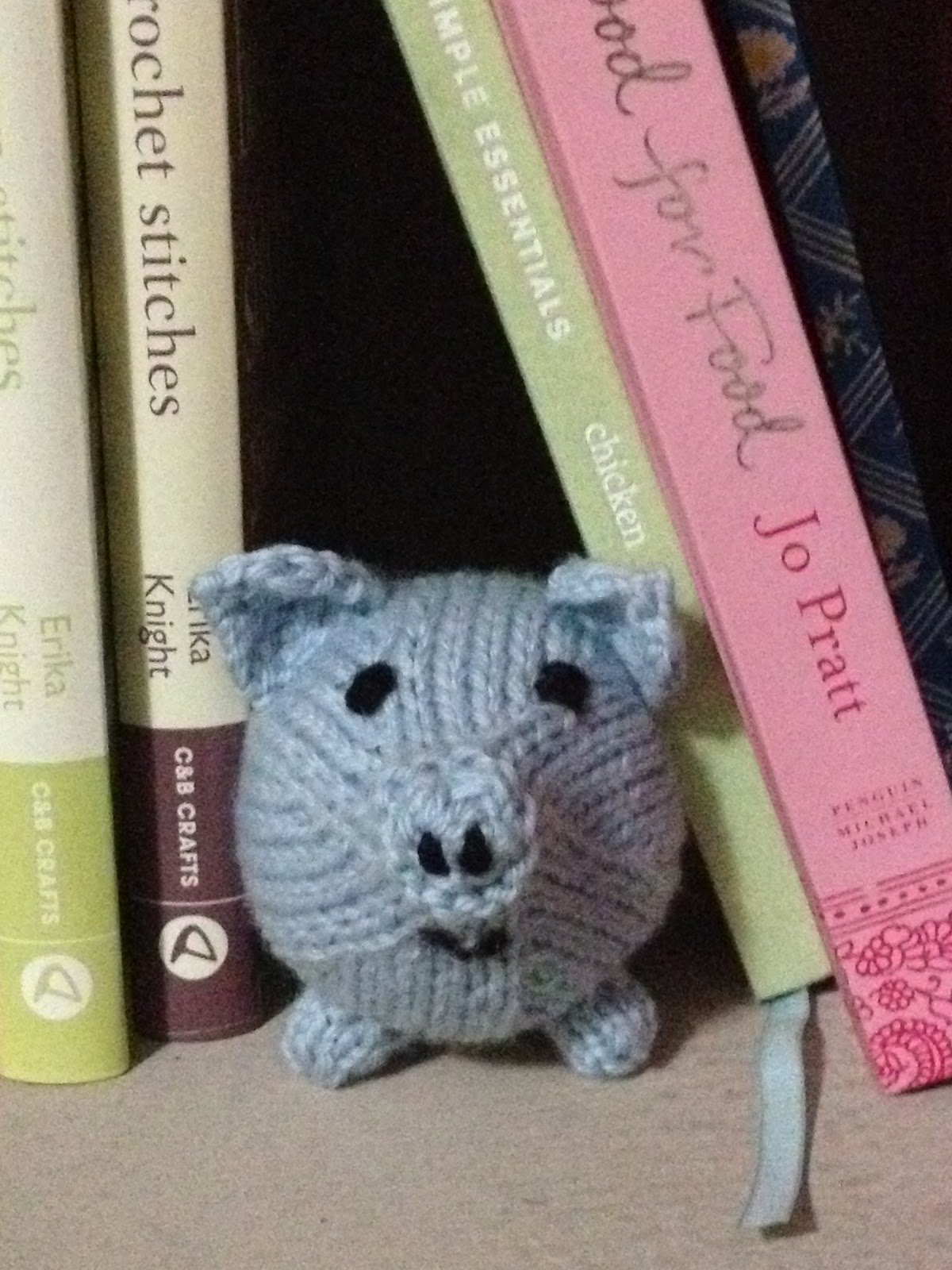
Craft: Knitted Pig a.k.a the "Pig-Mouse"

Pig-mice are small, mouse sized pigs who make their homes in bookshelves. I spotted this one between the knitting and cooking section.


 And again by the science fiction.


The pattern is from Spud and Chloe. It's actually an extremely cute flying pig. I've made the pattern three times and my attempts always come out slightly mousey - not that that's a bad thing exactly. Even when knitted in a more pig like colour, the effect is the same. I think it's the placement of the legs that make my pigs have pointy noises and therefore mouseyness! Regardless of whether it's a pig, a mouse or something in between, the results are still cute and it's a very easy pattern that can be made in a day if you're dedicated. Pig-mice make good last minute presents too.


Who wouldn't want to spy one of these little guys on their bookshelf??